
Case Study
FERNCOT - Operations Management Platform
INTRODUCTION
MY ROLE
As the Product & UI Designer, I was responsible for transforming the product vision into a clear, structured, and visually cohesive experience.
I handled the full design scope from understanding user flows and mapping information architecture and user flow, designing high-fidelity UI, and collaborating closely with the stakeholders and engineers for a smooth handoff.
THE CHALLENGE
Ferncot was designed to solve four major challenges faced by small to mid sized organizations mana-ging internal operations manually:
Scattered Workflows:
Teams relied on spreadsheets, emails, and chat threads to manage requests, making it difficult to track progress, reference requests and maintain consistency.
Approvals were often delayed or lost in communication loops, slowing down day to day operations.
Lack of Visibility:
Managers had no centralized dashboard to monitor progress, leading to delayed decisions; a pain point echoed by 74% of users interviewed. in my organization.
Poor Data Organization:
Reports and performance metrics were spread across multiple tools, making it hard to analyze or make data driven decisions.
One of the challenges that made understanding Ferncot so difficult was the question of
“How can operations and finance coexist seamlessly in one system?”
Designing an internal operations tool meant dealing with multiple moving parts from task requests and approvals to tracking financial deductions after payments were approved. The toughest part was finding the right balance between visibility and simplicity: managers needed to see financial impact without turning Ferncot into a complex accounting dashboard. Beyond that, building flexible approval hierarchies that worked for different organizations, keeping the interface intuitive for non-technical users, and maintaining design consistency across modules all added layers of complexity. Translating real, often messy operational processes into a clean, digital workflow required not just design skill, but empathy and deep problem-solving.
MY GOAL
To design a single, intuitive platform that centralizes operations, automates approvals, and gives managers/team leads a clear view of performance metrics across the organization.
RESEARCH INSIGHTS
To understand why internal operations felt chaotic, I sat with the people living through it operations officers, HR teammates, line managers, and everyday staff trying to get work approved. Across Lagos, Port Harcourt, and teams in Abuja (we have offices in these various locations), I observed the same pattern: everyone was creating order where tools had created disorder. Spreadsheets, emails, WhatsApp groups, random shared folders, all stitched together just to get one request across the finish line.
The most striking discovery wasn’t just the number of tools used, it was what they trusted. When workflows became complicated, people abandoned the “systems” and returned to familiar tools like Whatsapp and emails. They liked them because they were predictable. They knew where to click, what came next, and how to track a response. That became a critical insight: if simplicity already exists in their habits, the platform should build on that not fight it.
This shaped Ferncot’s product direction. The core features were designed to feel like working inside a structured environment with clear sections, logical steps, visible progress. No guesswork. No friction. Just workflows as straightforward as possible but automated and connected behind the scenes.
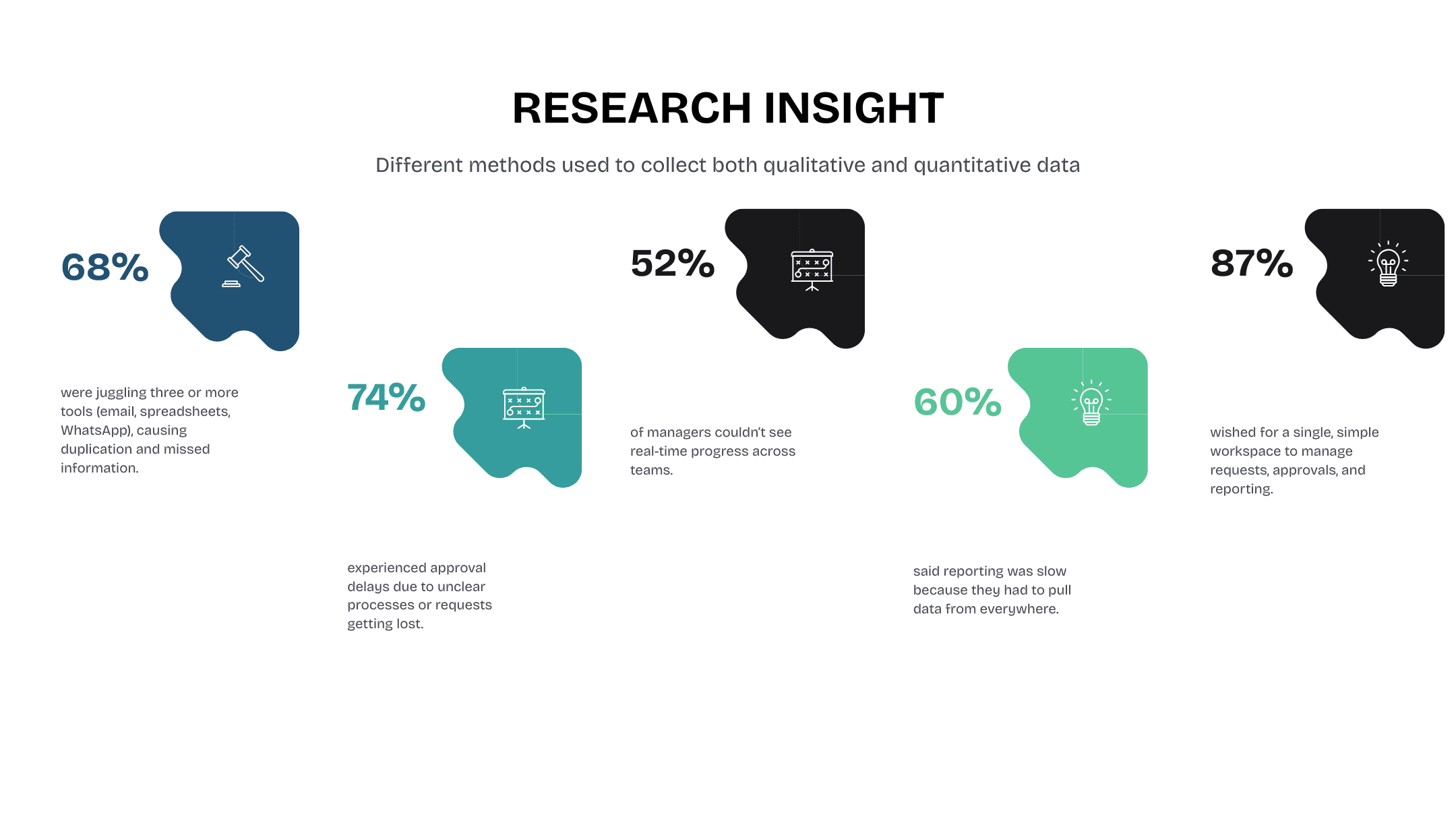
What the Research Revealed (at a glance)
68% were juggling three or more tools (email, spreadsheets, WhatsApp), causing duplication and missed information.
74% experienced approval delays due to unclear processes or requests getting lost.
52% of managers couldn’t see real-time progress across teams.
60% said reporting was slow because they had to pull data from everywhere.
87% wished for a single, simple workspace to manage requests, approvals, and reporting.
MY DESIGN PROCESS — DESIGNING WITH MY PAINT POINT AS CASE STUDY
Ferncot was the first fully live product I ever designed, and it began with a real internal problem my colleagues and I were facing. Our company had recently adopted Microsoft Dynamics 365 through an external agent and instead of improving workflow, it broke our workflow. Approvals got lost, requests became harder to track, and finance reconciliation became even more confusing. I realized the issue wasn’t the software itself, it was the lack of structure and true understanding of how our organization actually worked. That firsthand frustration became the foundation of my design process. Even without advanced research tools at the time, I listened closely to teammates in operations, HR, and finance to understand what truly needed fixing.
Using our everyday challenges as the core case study, I began mapping out what a smooth system should feel like. I focused on the essentials: raising requests, getting approvals, and seeing the operational and financial impact clearly in one place. I designed workflows that mirrored how teams already communicated, simple submissions instead of complicated forms, clear status updates instead of messy email trails, and dashboards that gave managers visibility without drowning them in data. The idea was to create what Microsoft Dynamics 365 couldn’t achieve for us: a platform that understood the moving parts of real operations and guided them gracefully from start to finish.
As the product evolved from whiteboard sketches to clickable prototypes, I collaborated closely with the engineer to turn the structure into an actual SaaS application. I learned quickly that internal operations are complex and simplifying them requires empathy more than perfection. Although I wasn’t yet measuring usability with sophisticated metrics, I measured success by clarity: colleagues could finally see how approvals, spending, and reporting connected.
In many ways, Ferncot wasn’t just the first live product I designed, it was the moment I discovered that great design isn’t about knowing every method, but about solving real problems with the tools and understanding you have.
KEY DESIGN OBJECTIVES
Streamline Core Workflows:
Help teams manage daily operations efficiently by mapping key processes such as task creation, inventory tracking, material purchase requests, trip approvals, and reporting, ensuring every workflow is intuitive and easy to follow.
Simplify the User Experience:
Reduce friction for non-technical users by designing clear user flows and wireframes that prioritize simplicity, speed, and ease of navigation across all modules.
Design for Clarity and Visibility:
Create a calm, structured interface using neutral colors, modular cards, and visible status indicators allowing users to track requests, approvals, and reports at a glance.
Ensure Scalable Collaboration:
Build a scalable system and work closely with the engineer to ensure seamless handoff and consistent implementation across the entire platform.
PROPOSED SOLUTION
Designing Ferncot was about creating a unified system where operations, approvals, and finances worked together seamlessly.
To address scattered workflows: Ferncot requests was developed to centralize all submissions from material purchases to maintenance tasks and trip plans. It eliminated tracking confusion by allowing employees to raise, monitor, and manage requests in one place.
For faster decision-making: Ferncot approvals gave managers a focused workspace showing essential context, cost, purpose, and urgency, so they could act quickly and confidently. This reduced approval delays and removed unnecessary back and forth communication.
To bridge the gap between operations and finance: Finance view connected approved requests directly to their corresponding deductions and expenses. It offered transparency without clutter, helping managers see financial impact instantly.
Finally, Ferncot Reports brought everything together with a centralized analytics dashboard that visualized performance metrics, spending trends, and approval timelines. It gave leaders the visibility they needed to make informed, data backed decisions.
Together, these solutions transformed Ferncot from a basic request tool into a complete operations management platform empowering teams to work smarter, faster, and with full visibility across every department.
KEY TAKEAWAYS FROM THIS PROJECT
The messiest problems make the clearest design briefs.
Ferncot's chaos: spreadsheets, WhatsApp chains, lost approvals gave me everything I needed to know about what the product had to fix. Clarity of problem leads to clarity of solution.
Operations and finance can coexist cleanly
it just takes ruthless prioritization. Connecting approval workflows to financial deductions without creating an accounting dashboard was the hardest UX challenge of this project. Solving it taught me how to find the line between useful visibility and overwhelming data.
Designing for non-technical users means designing for trust
If a staff member can't predict what happens next when they click a button, they'll stop clicking. Every flow in Ferncot was designed to feel predictable, calm, and in control.
Designing for Real People
Not everyone using Ferncot was tech savvy, so simplicity and clear communication became top design priorities. Being that it was my first project I was lost at different stages and had to interact with people to understand thing from their point of view so I don’t design out of scope.
OUTCOME / IMPACT
Ferncot went from a whiteboard problem to a fully designed and development ready SaaS platform; the feedback from both the development team and early test users confirmed the design direction was right. Navigation felt intuitive on first use. The approval to finance flow, which was the trickiest problem to solve, was immediately understood without instruction. That's the clearest signal a product designer can get.
More personally, Ferncot was the project that proved to me that the best design research sometimes comes from living the problem yourself. Working inside a corporate organization where operations regularly broke down gave me an empathy that no interview guide could manufacture. That insider perspective is now a consistent part of how I approach every operations or workflow product I design.
The platform is currently in final development for live implementation and the architecture and UI system I delivered are being built out as is, with no structural redesign required.